
Maps & Pathways — Talent development platform for complex organisations

Guidance Suite
Current route:Reference

Move between role journeys, reference tools, and source materials without losing your place.

Maps & Pathways Guidance

Reference Library

Models to use before, during, and after the conversation

Use these models as light-touch tools when the conversation needs a bit more structure. They are there to support judgement, not replace it.

7
Reference models
4
Model families
1
Goal: better movement
Choose A Tool

Start with the kind of help the conversation needs

The fastest way into the toolkit is to name the problem first. Are you trying to listen better, reflect more clearly, structure feedback, or help someone move?

Listening

When attention or empathy is the issue

Use a listening model when the conversation is struggling because someone is not yet truly hearing what is being said.

  • Check whether the conversation is drifting, defensive, or waiting to disagree.
  • Use Listening Staircase to name the quality of listening in the room.
  • Move toward empathy before trying to move toward action.
Reflection

When an experience needs unpacking

Use reflection models when someone needs to make sense of an event, understand what shaped it, and learn from it properly.

  • Start with reflective learning as the wider habit.
  • Use Gibbs for a structured look back at one event.
  • Use GROW when reflection now needs to become a plan.
Feedback

When behaviour or performance needs structure

Use a feedback model when you need enough structure to stay clear and fair without turning the conversation into a script.

  • Use SBII for one behaviour or moment that needs naming.
  • Use CEDAR when the issue is broader and follow-through matters.
  • Keep examples specific and proportional.
Change

When insight must turn into movement

Use change-focused models when the person feels heard and the next job is to help them move toward a credible next step.

  • Use GROW to move from goal to commitment.
  • Use Listening for Change when trust, influence, and progression are the live challenge.
  • Translate insight into a small, real next move.
Use Them Well

A model should sharpen the conversation, not take it over

These tools work best when they add just enough structure to make the conversation clearer and more useful.

  • Pick the lightest model that helps rather than reaching for the most elaborate one.
  • Use the model to sharpen judgement, not to replace it.
  • Be explicit about what problem you are trying to solve before choosing a tool.
  • Stop if the model is making the conversation feel mechanical or defensive.
  • End with a next step, not just a better description of the issue.

Rule of thumb

If you are using a model to avoid professional judgement, you are using it badly. If you are using it to help someone think more clearly, reflect more honestly, or commit more concretely, you are probably using it well.

Listening And Reflection

Build understanding before you try to push for action

The source pack puts listening and reflective learning at the foundation. These are the models that help someone feel heard, unpack an event properly, and learn from it rather than just relive it.

ListeningListening Staircase+

A quick check for how deeply you are really listening during the conversation.

  • Ignoring: there, but not present.
  • Pretend listening: waiting to speak.
  • Selective listening: waiting to disagree.
  • Active listening: listening to understand and engage.
  • Empathetic listening: listening for feelings and perspective.
Use it when you need to diagnose the quality of listening before trying to solve the issue itself.
ReflectionReflective learning+

A way to turn an experience into useful learning instead of simply replaying it.

  • Builds self-awareness and sharper judgement.
  • Connects experience to future action.
  • Can happen after the event or in the moment.
Use it when you want to turn an experience into genuine learning rather than just replaying it.
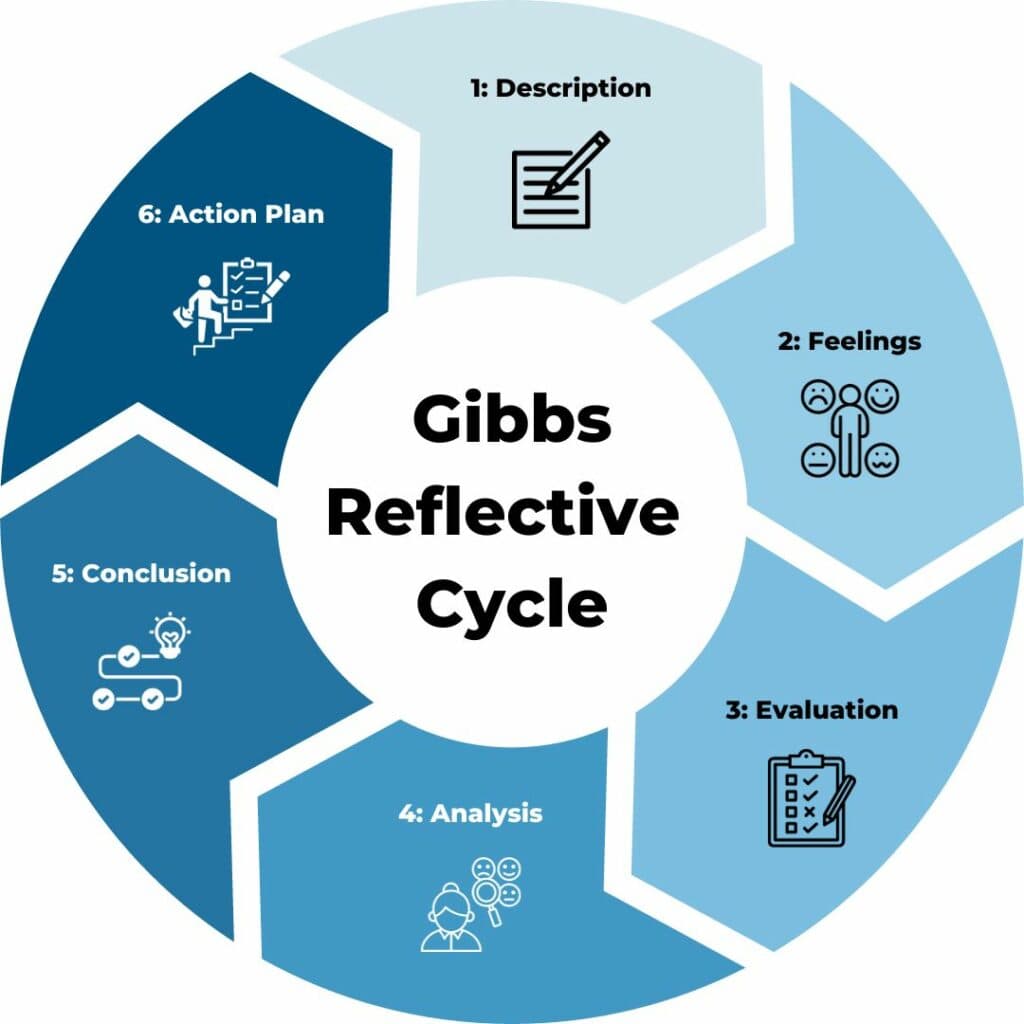
ReflectionGibbs Reflective Cycle+

A step-by-step model for moving from description through to an action plan.

  • Description
  • Feelings
  • Evaluation
  • Analysis
  • Conclusion
  • Action plan
Use it when a specific event needs a disciplined reflection path from facts through to a concrete next move.
CoachingGROW+

A coaching model that moves from the desired outcome to a committed way forward.

  • Goal
  • Reality
  • Options or obstacles
  • Way forward or will
Use it when reflection has gone far enough and the person now needs ownership, options, and commitment.
After The Event

Reflection-on-action

Use it after the event when there is enough distance to analyse decisions, connect practice to theory, and work out what needs to change next time.

  • Retrospective and deliberate.
  • Best for deeper learning and longer-term development.
  • Useful when the conversation needs a calmer second look.
In The Moment

Reflection-in-action

Use it during the event when you need to notice what is happening, adjust quickly, and respond with better judgement while the situation is still unfolding.

  • Real-time and adaptive.
  • Depends on self-awareness and situational awareness.
  • Useful when the meeting needs an immediate reset or change of approach.
Gibbs Reflective Cycle diagram showing six stages from description through to action plan.
Reflection

Use Gibbs when a specific event needs unpacking properly

Gibbs is particularly useful after a difficult meeting or critical incident because it slows the reflection down enough to move from memory and emotion into analysis and action.

Feedback And Change

Use more structure only when the issue needs it

Once the issue is clearer, feedback and change models help you keep the conversation fair, specific, and forward-moving without collapsing into scripts.

FeedbackSBII+

A clear way to describe what happened while still making space for intent and perspective.

  • Situation
  • Behaviour
  • Impact
  • Intent
Use it when one behaviour or moment needs to be described clearly while still making space for perspective and intent.
FeedbackCEDAR+

A broader feedback model that helps you move from examples into diagnosis, action, and review.

  • Context
  • Examples
  • Diagnosis
  • Action
  • Review
Use it when the issue is broader than a single moment and the conversation needs diagnosis, action, and follow-through.
ChangeListening for Change+

An extended model that links good listening to rapport, influence, and meaningful change.

  • Steps 1 to 5 are discovery.
  • Step 6 is rapport built through genuine understanding.
  • Step 7 is influence earned through trust.
  • Step 8 is positive change: turning insight into the pathway ahead.
Use it when the person feels heard and the real challenge is helping them move from reflection into progress.
Listening For Change

Move from discovery into progression

Maps and Pathways extends the Listening Staircase into a fuller change model. The first five steps are about discovery. The last three are about building trust, earning influence, and turning insight into a pathway ahead.

Discovery

Steps 1 to 5: understand properly before you guide

The early steps move from poor listening through to empathetic listening so the other person's logic, feelings, and context can be understood properly.

  • Ignoring
  • Pretend listening
  • Selective listening
  • Active listening
  • Empathetic listening
Progression

Steps 6 to 8: turn trust into movement

The later steps are about building rapport, earning influence, and helping someone move from reflection into a credible next step.

  • Rapport
  • Influence
  • Positive change

The behavioural loop underneath the model

The pack frames behaviour as something driven by feelings, which are themselves shaped by experience. That is why the model spends so much time on listening and rapport before it tries to move into influence and action.

DiscoveryWhat discovery looks like in practice+

The first five steps are about improving the quality of listening in the room before anyone tries to push for agreement or action.

  • 1. Ignoring: There, but not present. The conversation cannot progress because attention is not really in the room.
  • 2. Pretend listening: Listening in appearance only. The mind is elsewhere or simply waiting for a chance to speak.
  • 3. Selective listening: Only parts of the message are being heard, usually the parts that trigger agreement, disagreement, or self-protection.
  • 4. Active listening: The literal content is being heard properly and responded to with attention and care.
  • 5. Empathetic listening: The listener is trying to understand the speaker's feelings, logic, and context rather than only the facts on the surface.
ProgressionWhat progression looks like in practice+

Once the person feels understood, the model moves into rapport, influence, and positive change so insight becomes a pathway ahead rather than just a moment of reflection.

  • 6. Rapport: Trust grows because the other person feels genuinely understood, not managed or performed at.
  • 7. Influence: Guidance is now more likely to land because it has been earned through understanding rather than imposed too early.
  • 8. Positive change: Insight becomes a pathway ahead. The outcome is not just understanding but a credible move toward better behaviour, performance, or decision-making.